

New fossil find may shed light on how sabre toothed predators evolved
- Julien Benoit
Prehistoric bestiary is full of remarkable creatures and fearsome predators.
Sabre toothed cats, with their long, protruding canines, are probably the most recognisable, and have featured a great deal in popular culture like books and .
The 第一吃瓜网 continent had its fair share of these sabre toothed cats. were Megantereon, Homotherium and Dinofelis, which shared the ancient landscape with our human ancestors, the early hominims, between one million and five million years ago.
But those cats weren鈥檛 the first sabre toothed predators to roam Africa. Some 250 to 260 million years ago, during the Permian period, the world鈥檚 most feared sabre toothed predators were .
These sabre toothed carnivores belonged to the family of reptilian-looking mammalian ancestors called the Therapsida. They were found across the continent we know today as Africa, from the south to as far north as . Gorgonopsians reigned supreme at the top of the food chain for about 10 million years before they were wiped out during the end of the Permian mass extinction event .
Now a team from the Evolutionary Studies Institute at South Africa鈥檚 University of the Witwatersrand has discovered the fossil remains of what may be the oldest large-sized gorgonopsian ever found. The extremely well preserved fossil was found in Laingsburg, a town in South Africa鈥檚 arid Karoo region.
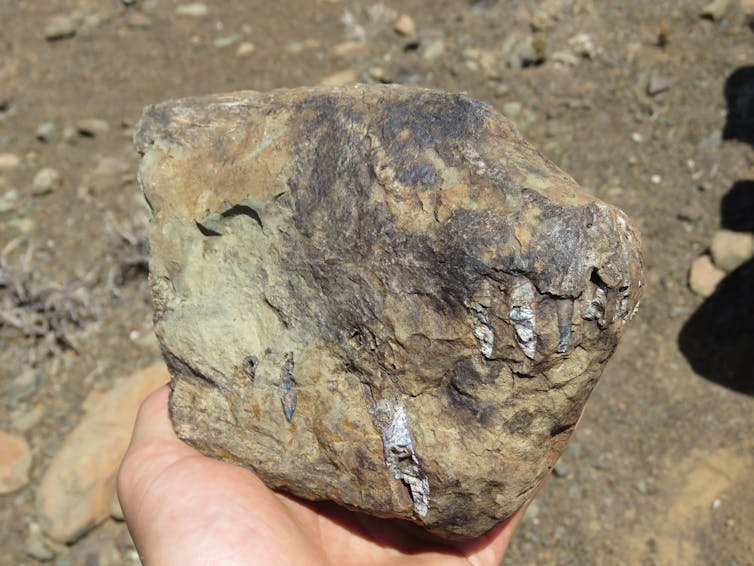
Gorgonopsians have previously been discovered in similar rock layers from the same area, but these were poorly-preserved specimens of . The skull we found is complete, undeformed and lion-sized. This is an important discovery from an evolutionary point of view, because it would show that gorgonopsians started out big. That contradicts what鈥檚 known in science as , which states that species tend to start small and grow bigger as they evolve.
Why sabre teeth?
This discovery, as with any others that involve sabre toothed animals, is also important because it could shed light on how the predators actually used their terrifying teeth.
Some scientists it was a lethal stabbing weapon used to pierce prey鈥檚 carotid arteries. Some gorgonopsian species had canines longer than the . Others 鈥� 鈥� argue that a long canine is also represented in herbivores, such as the or the , which use it for display to attract mates. Gorgonopsians could have had sabre teeth for the same reason. And, of course, the two hypotheses may not be mutually exclusive.
The only way to answer this question definitively is to find more well preserved fossils such as the recently discovered Laingsburg specimen. With more fossils, we might be able to find out whether both male and female gorgonopsians had sabre-like canines.
If only males did, this could mean the teeth were only important for parading themselves to females, or fighting with other males 鈥� rather than for hunting.
More fossils needed
The newly discovered large gorgonopsian will now have to be studied carefully to ascertain exactly what we鈥檝e found and what its significance may be. It is currently being cleaned and prepared by technicians at the Evolutionary Studies Institute to remove the rock matrix from the bones. This process can take several months. Then, the discovery will have to be published in a peer-reviewed journal, accompanied by a full description and, possibly, a new species name.
Then 鈥� with 鈥� we plan to head back into the field. It鈥檚 very possible that there are more beautifully preserved fossils to be found in the Laingsburg area.
With enough fossils, we may get a clearer picture of the ancient Permian environment and be able to solve the mystery of the origin, evolution and death of the 鈥渒ing of the Permian jungle鈥�.
, Postdoc in Vertebrate Palaeontology, . This article is republished from under a Creative Commons license. Read the .